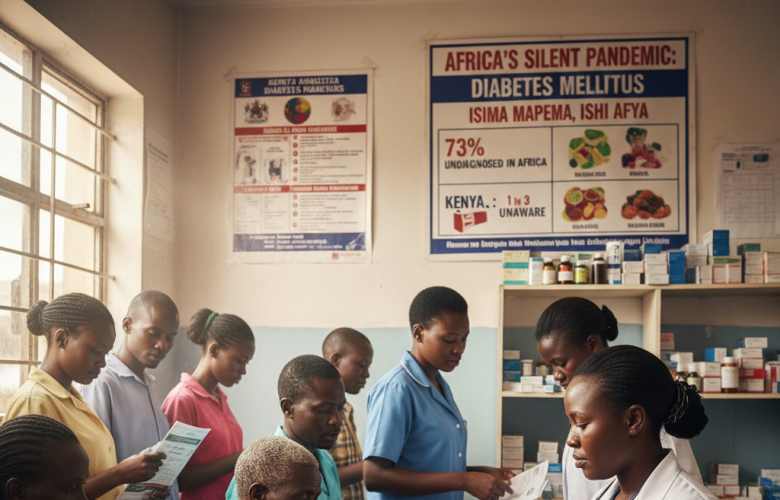
The African continent is in the midst of a rapid epidemiological transition, facing a "double burden" of persistent communicable diseases and a burgeoning epidemic of Non-Communicable Diseases (NCDs), with Diabetes Mellitus (DM) at the forefront. For healthcare professionals (HCPs), understanding the gravity and unique challenges of this crisis is crucial for impactful clinical and policy interventions.
The Status and Prevalence
of Diabetes in Africa
The figures from the International Diabetes Federation (IDF) and
the World Health Organization (WHO) paint a concerning picture of a condition
that has transitioned from being rare to one of Africa’s major public health
threats.
·
Soaring Prevalence: The
prevalence of diabetes among adults in the WHO African Region has surged,
reaching an estimated 10.5% in 2022 (1). The total number
of adults (20–79 years) living with diabetes is estimated at 25 million (2).
·
Undiagnosed Majority: The
most alarming statistic is the staggeringly high proportion of undiagnosed diabetes, estimated to be around 73% across the region (2). This means approximately 18 million adults are unaware of their condition, the
highest percentage globally (3).
·
Premature Mortality:
Premature deaths from diabetes (occurring before the age of 70) stand at 58% in the African Region, significantly higher than
the global average of 48% (3). This highlights late diagnosis and inadequate
management as major challenges.
·
The Driver: Urbanization and Lifestyle: The
rise is largely attributed to rapid urbanization and the
resultant adoption of sedentary lifestyles, shifts towards energy-dense diets,
and increasing rates of obesity and physical inactivity. Type 2 Diabetes
Mellitus (T2DM) accounts for over 90% of cases (4).
Narrowing the Focus:
Diabetes in Kenya
Kenya mirrors the continental trend, presenting a critical need
for strengthened NCD care.
·
Current Estimates:
According to the IDF, Kenya has an estimated diabetes prevalence of 3.1% in the adult population (20-79 years) (5),
equating to approximately 813,300 adults
living with the condition (as of 2025 projections). The WHO STEPS 2015 survey
placed the national prevalence at 3.3% (6).
·
The Undiagnosed Gap in Kenya: The
problem of late diagnosis is acute, with an estimated 53.6% of people with diabetes in Kenya remaining
undiagnosed (5). This leads to significant morbidity, with many patients
presenting with life-threatening complications like gangrene, kidney failure,
or diabetic ketoacidosis (7).
·
Geographic Disparities and Earlier Onset:
Prevalence is generally higher in urban areas (e.g.,
studies show Nairobi with higher rates) (8). Moreover, Kenyan patients are
often at risk of developing T2DM-related complications at an earlier age compared to those in developed countries
(8).
The
Challenges for Healthcare Providers
The complexity of diabetes management in Kenya is amplified by
systemic and economic barriers that HCPs must navigate:
1. Late
Diagnosis and Advanced Complications: By the time many
patients are diagnosed, serious complications are often already setting in.
This places a heavy burden on tertiary facilities, where lack of supplies and
trained staff exacerbates poor outcomes (9).
2. Affordability
and Financial Burden: The cost of consistent care is often prohibitive. Insulin, test
strips, and regular consultations are often paid for through high out-of-pocket expenditure, creating a major barrier to
adherence and glycemic control for the majority of patients (7).
3. Fragmented
Care Systems: The health system, still juggling the infectious disease
burden, struggles with the transition to effective chronic disease management.
There remains a significant gap between national diabetes policy and its
effective implementation at the grassroots level (9).
Call
to Action for HCPs
The growing burden of diabetes demands a coordinated,
multidisciplinary response. HCPs are on the front lines and must champion a
shift in strategy:
·
Integrate Opportunistic Screening:
Aggressively integrate screening for at-risk individuals (e.g., those with
hypertension, obesity, family history) into every clinical encounter at the
primary care level.
·
Enhance Capacity Building: Push
for increased access to and training in the WHO-led PEN-Plus
strategy, which aims to increase access to diagnosis, treatment, and care of
severe chronic diseases at district hospitals (3).
·
Patient Empowerment: Move
beyond prescription to empower patients through robust, culturally relevant
education on nutrition, physical activity, and self-monitoring to improve
long-term adherence and outcomes.
References
1. - WHO
Regional Office for Africa. Diabetes. Available at: https://www.afro.who.int/health-topics/diabetes
2. - International
Diabetes Federation (IDF). Africa | Regions. Available at: https://idf.org/our-network/regions-and-members/africa/
3. WHO
Regional Office for Africa. African region tops world in undiagnosed
diabetes: WHO analysis. Available at: https://www.afro.who.int/news/african-region-tops-world-undiagnosed-diabetes-who-analysis
4. - Owolabi
MO, et al. Diabetes in sub-Saharan Africa – from policy to practice to
progress: targeting the existing gaps for future care for diabetes. Diabetes and Vascular Disease Research.
2017;14(4):259-269. Available at: https://pmc.ncbi.nlm.nih.gov/articles/PMC5489055/
5. - International
Diabetes Federation (IDF). Kenya Diabetes Data & Insights | IDF
Atlas. Available at: https://diabetesatlas.org/data-by-location/country/kenya/
6. - WHO
Regional Office for Africa. Diabetes is a family affair in Kenya.
Available at: https://www.afro.who.int/news/diabetes-family-affair-kenya
7. - TRT
Afrika. Africa's diabetes crisis: When a foot sore ends in amputation.
Available at: https://www.trtafrika.com/english/article/675765abdfc5
8. - Wamuyu-Maina
GW, et al. Prevalence of diabetes and co-morbidities in five
rural-and-semi-urban Kenyan counties: 2010–2015. International Journal of
Diabetes Mellitus. 2017;5(2):98-103. Available at: https://www.researchgate.net/publication/318239463_Prevalence_of_diabetes_and_co-morbidities_in_five_rural-and-semi-urban_Kenyan_counties_2010-2015
9. - Gathuru
IM, et al. Challenges in policy reforms for non-communicable diseases: the
case of diabetes in Kenya. Global Health Action.
2019;12(1):1611243. Available at: https://www.tandfonline.com/doi/full/10.1080/16549716.2019.1611243
Subscribe to our newsletter for the latest medical news and insights.
Get notifications and offers as they happen.